

-
School of Medicine
-
Educational Content
-
Prospective Students
-
Current Students and Alumni
International Affairs
-
Graduate School of Medicine
-
Educational Content
-
Prospective Students
-
International Affairs
-
Graduate School of Biomedical Science and Engineering
-
Educational Content
-
Prospective Students
-
Other
-
Faculty of Medicine
-
Organizational Structure
-
Industry-academia Cooperative Projects
-
Overview
-
Entrance Examinations
-
Publications and Promotional Material
-
Various Types of Data
Center for Medical Education and International Relations
- HOME
- General Information
- Facilities and Equipment
- Center for Medical Education and International Relations
Content Menu
Center for Medical Education and International Relations
(Established: September 1, 2010; reorganized: April 1, 2025)
The purpose of this Center is to conduct research on and development of general and simulation-based medical education inside the Faculty of Medicine. It is also instrumental in the enhancement of the practical clinical competencies of the University's students, faculty, and staff engaged in healthcare by planning, drafting, and coordinating initiatives related to education in the Graduate School and School of Medicine, and also works in collaboration with overseas universities and other institutions. It also promotes education, training, and professional development using medical simulators. The Center further aims to contribute to the advancement of medical education and the promotion of international exchanges within the Faculty of Medicine, the Graduate School of Medicine, and the School of Medicine.
(As of April 1, 2025)
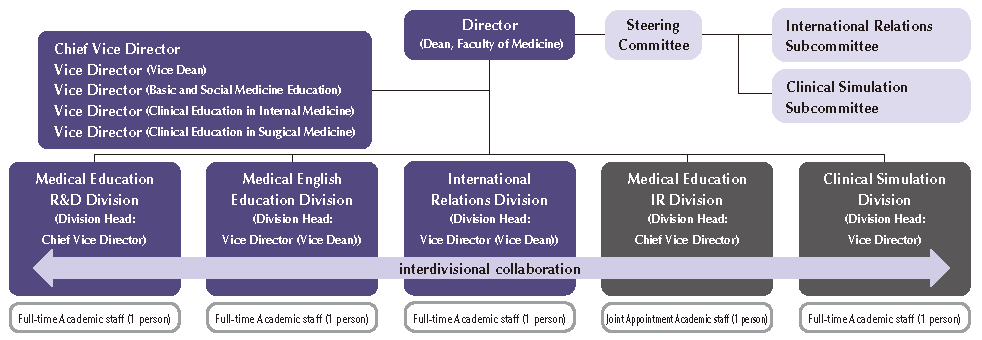
Steering Committee
The committee is tasked with deliberations on important matters regarding the center, as follows:
- (1) Academic staff
- (2) budgeting and settlement of accounts
- (3) international relations
- (4) operations of the Center
- (5) events held by the Center
- (6) other important matters related to the Center
Executive Committee
The Executive Committee is set up within the Center for Medical Education and International Relations of the Hokkaido University Faculty of Medicine to examine specific implementation measures of programs and events that are designed and planned by the Center and to implement them in collaboration with the Faculty of Medicine, Graduate School of Medicine, School of Medicine and Hokkaido University Hospital.
【Mission】
Medical Education R&D Division
The Medical Education R&D Division conducts research on and development of medical educational initiatives. With the aim of enhancing the practical clinical competency of the University's students, faculty, and staff engaged in healthcare, it is also responsible for the administration and management of Common Achievement Tests (CBT and OSCE), as well as the planning, drafting, and implementation of faculty development (FD) programs. The division also organizes and manages pre-clinical training (the 4th-year “clinical diagnostics practicum”), clinical clerkships (the 5th-year “core clinical clerkship”), and training programs for clinical instructors, thereby contributing to the advancement of participationbased clinical education in the School of Medicine.
Medical English Education Division
The Medical English Education Division aims to strengthen the three core medical English competencies of (1) medical communication (communication between physicians and patients, as well as communication among physicians), (2) medical research, and (3) clinical skills (history taking and physical examination, clinical reasoning, and patient safety). Through medical English, the division provides an integrated curriculum that extends from basic medical knowledge to advanced clinical skills and professional development. The division offers the second-year course “Medical English Course” for medical students, and in collaboration with the Medical Education R&D Division, it is also involved in the 3rdyear “Medical Research Training” and the 6th-year “interprofessional/simulation trainings.” To foster the next generation of physicians with an international perspective, the division established the student group “DREAMERS,” which aims to cultivate motivated medical students who will contribute to healthcare both in Japan and abroad. For undergraduate and graduate students, as well as faculty members of the School of Medicine, the division hosts cutting-edge webinars to share the latest trends in education and research. It strives to ensure that all students grow into physicians who are empathetic, highly skilled, professionally competent, and globally minded, with the ultimate goal of contributing to the future of healthcare that meets the needs of both local and international communities.
Medical Education IR Division
The Medical Education IR Division was newly established in April 2025 with the aim of collecting and analyzing educational data from the School of Medicine, as well as gathering information on medical education. In collaboration with the Higher Education Research Division at the Office of Institutional Research, the Medical Education IR Division will perform data collection and analysis.
Clinical Simulation Division
The Clinical Simulation Center of the Graduate School of Medicine, Hokkaido University (reorganized in April 2025 as the Clinical Simulation Division within the Center for Medical Education and International Relations), is the University's largest facility for simulation-based education.
Spanning approximately 1,234 m2 across the 2nd, 3rd, and 5th floors of the Interprofessional Education and Research Building, it houses nine clinical training rooms, two advanced simulation rooms, and seven seminar rooms (A-G). Through practical training using simulators and mock patients, a wide range of learners—including medical, dental, pharmaceutical, nursing, and health sciences students, as well as residents, nurses, and pharmacists—can acquire skills in such fields as OSCE, surgical, emergency, and intensive care procedures, and patient safety in a safe and repetitive manner. The facility is equipped with wired and wireless LAN, one-way mirrors, and recording and streaming systems, enabling objective feedback and remote instructions after simulations. Since its opening in April 2016, it has served as a core facility to foster high-quality healthcare professionals and promote a culture of patient safety, while advancing educational, research, and community healthcare collaboration both within and outside the University.
International Relations Division
(International Relations Office: established on July 13, 2006; reorganized on April 1, 2018)
Followed by the recent trend of globalization, the International Relations Division was established to further enhance the international profile of the School of Medicine, the Graduate School of Medicine, and the Faculty of Medicine on the international scene to promote the internationalization of education and research.
In the field of education, we seek to foster future professionals through in-bound and out-bound student exchange programs to develop individuals capable of playing active roles on the global stage. Creating a firm partnership with overseas universities and research institutions is essential to practice close and sustainable international relationships.
To facilitate smooth and robust student exchange program for both native and overseas medical students, we proactively support students by concluding inter-university and departmental exchange agreements with outstanding universities to provide quality education to meet the needs of the times.
Due to the COVID-19 pandemic, student exchange programs with our partner universities were temporarily suspended from FY 2020 to 2022. During this period of inactivity, we have however reviewed the student exchange program and improved our crisis management system to ensure the safe and secure implementation of international exchange activities, even amid the COVID-19 pandemic, and have resumed phased dispatch of 6th-year students abroad and hosting of international students from overseas partner universities for clinical electives since FY 2023.
In the field of research, we provide indirect support for international students enrolled in the Graduate School of Medicine who has started to build a career path as a researcher. Graduate students from various countries are enrolled in our doctoral and master's programs, studying in an environment significantly different from their home country. Full-time staff and students support staff of the International Relations Division provides students with advice and assistance to create a secure environment for students to spend a comfortable campus life.
To disseminate efforts both inside and outside the university, we publish the newsletter Voice of the International Students (VIS) in the hope to further propel internationalization.